
Last updated August 25, 2026
Free on-site gate assessment - hinges, posts, and your LiftMaster or Nice gate operator checked before anything is quoted
The assessment is free and the quote is the invoice.
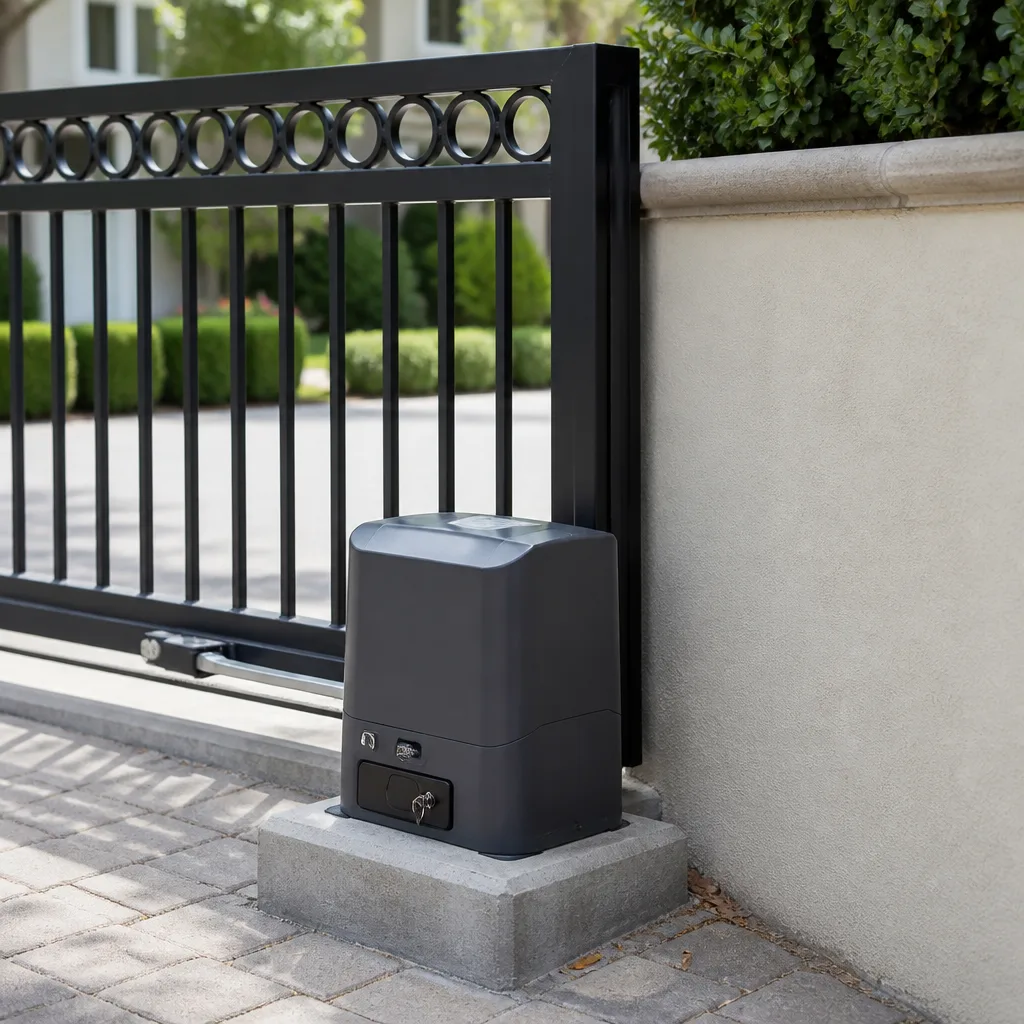
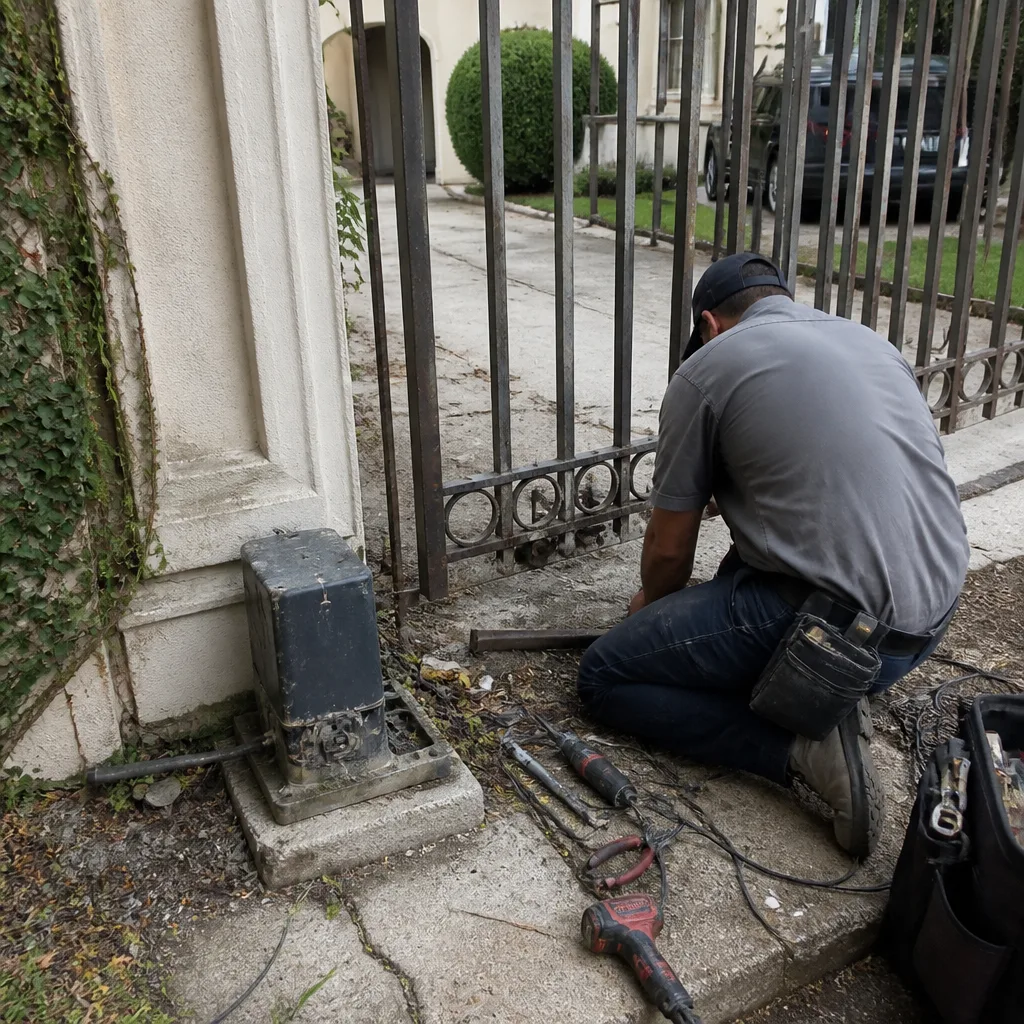 Before
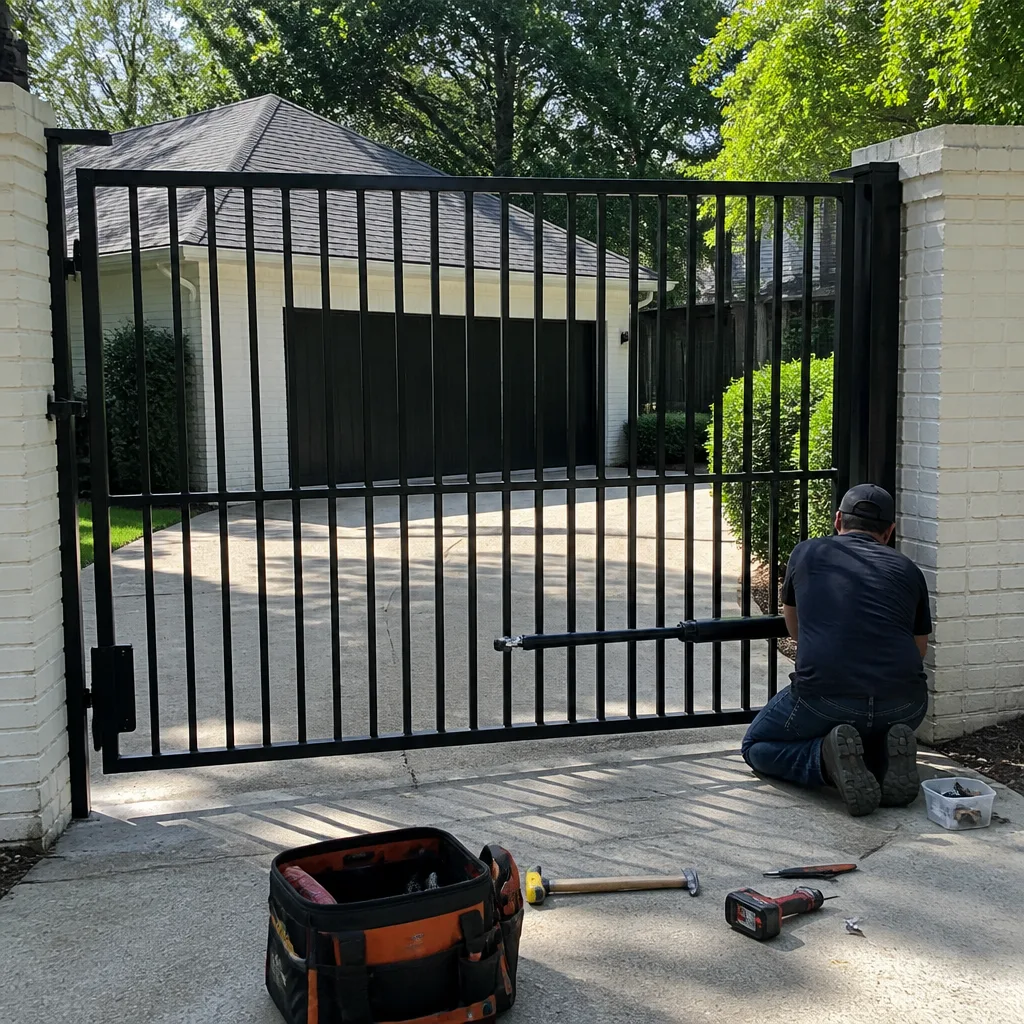 After
After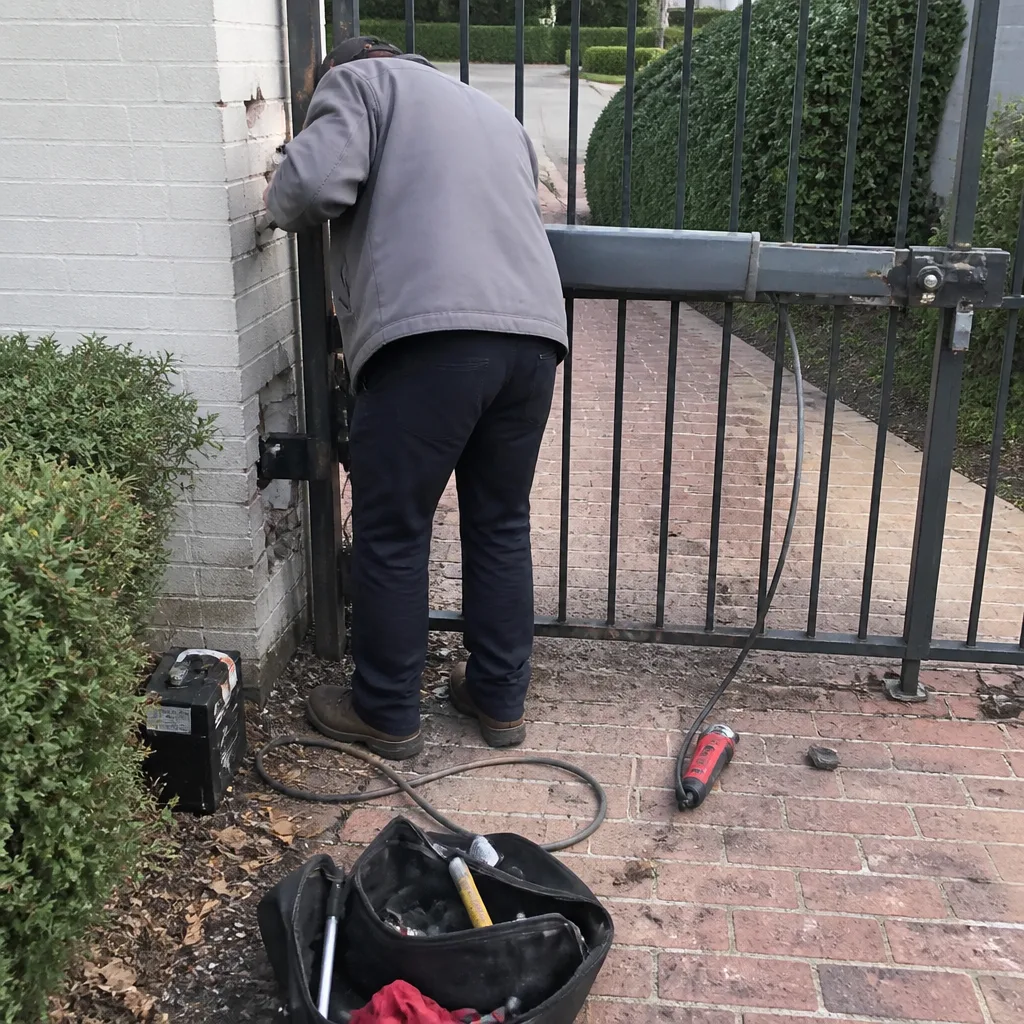 Before
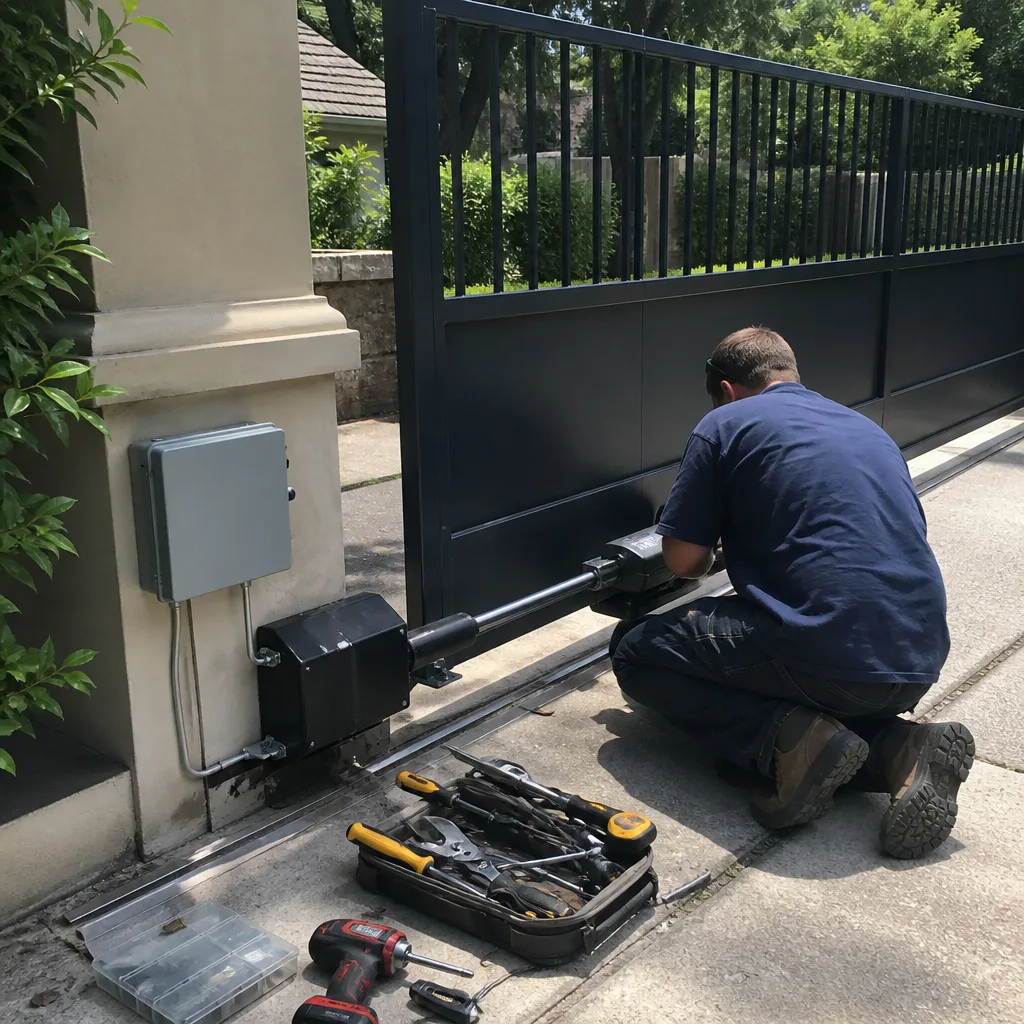 After
After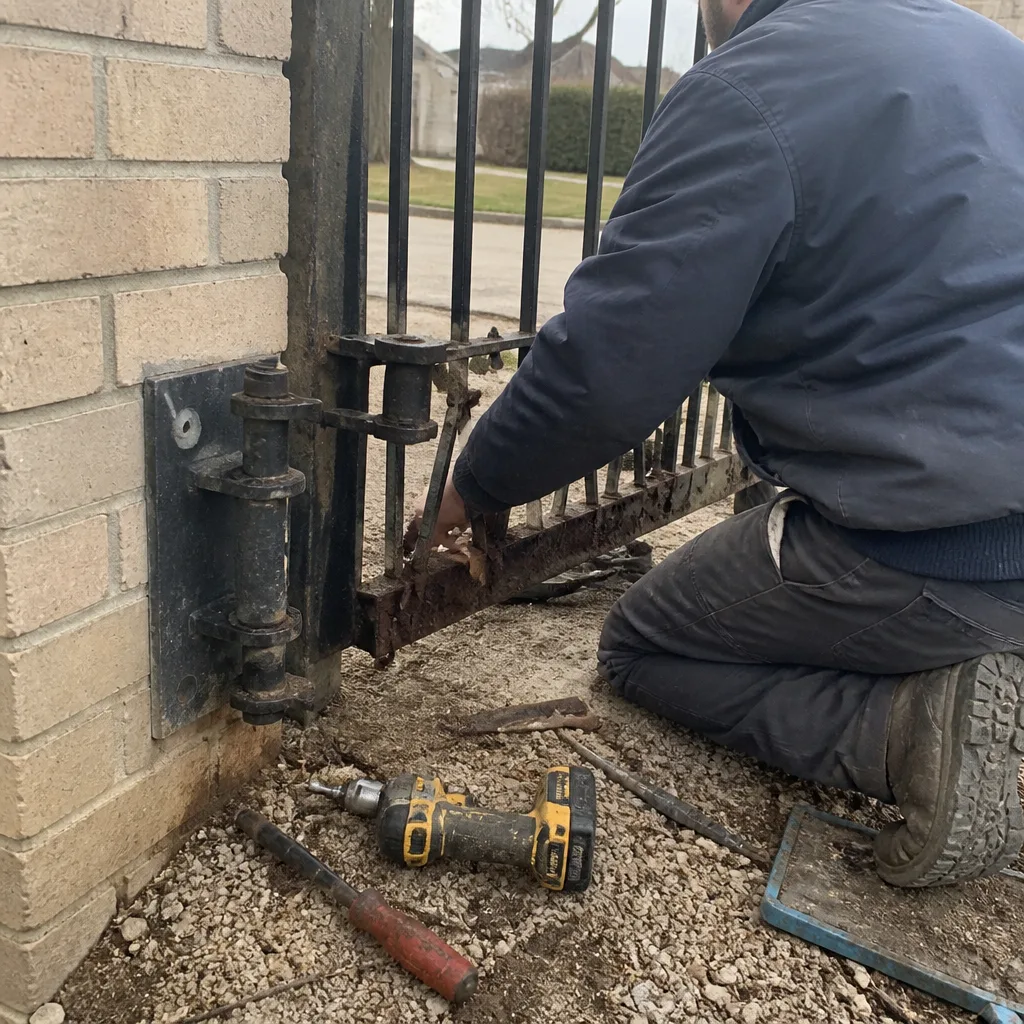 Before
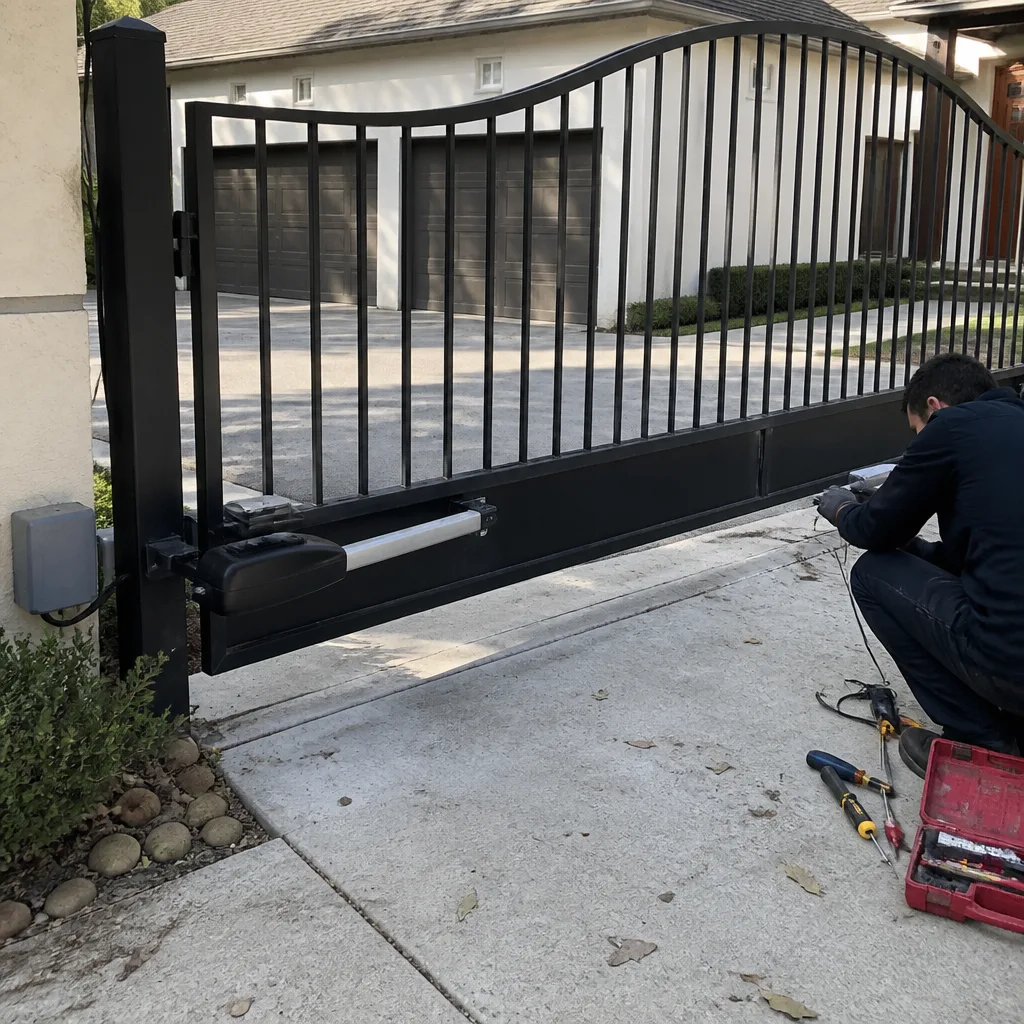 After
AfterDIY vs Professional Gate Repair: The Highland Park Homeowner’s Decision Guide
Here’s something most Highland Park homeowners don’t realize until it’s too late: the gate is usually the hardest-working mechanical system on the property, and it’s the one that gets the least attention until it fails. A driveway gate in Highland Park cycles open and closed thousands of times a year, through June heat that bakes the control boards and February cold snaps that make steel contract and bind. This guide walks through what you can safely handle yourself, what you should never touch, and how to make the call without wasting money or putting yourself at risk. We’ll cover costs, common failure points, the brands we see most often in Highland Park, and the honest truth about when DIY makes sense and when it doesn’t.
Quick Answer
For most Highland Park homeowners, minor maintenance like cleaning photo-eye lenses, tightening visible bolts, and lubricating hinges is reasonable DIY work, but anything involving gate motors, springs, control boards, or safety sensors should be left to a professional. The cost difference between a botched DIY repair and a proper fix is usually two to three times the original quote, and a gate that fails closed can trap vehicles or create a security gap that matters in a neighborhood like Highland Park. If the gate won’t open, won’t close, or moves unevenly, call a specialist before you make it worse.
Table of Contents
- What You Can Safely Handle Yourself
- What You Should Never DIY
- The Real Cost Breakdown: DIY vs Professional in Highland Park
- The Most Common Gate Failures on Highland Park Properties
- Brand-Specific Repair Realities
- How to Assess Your Gate Before You Do Anything
- Common Mistakes to Avoid
- When to Call a Professional
- Frequently Asked Questions
- The Bottom Line
What You Can Safely Handle Yourself
There’s a narrow but real band of gate maintenance that a careful Highland Park homeowner can do without special training or tools. The key word is maintenance, not repair. You are preventing problems, not fixing them. Here’s what that looks like in practice.
1. Cleaning the photo-eye lenses. These are the small sensors on either side of the gate opening, usually a few inches off the ground. Highland Park dust and pollen coat them within weeks, especially in spring when live oaks drop yellow film on everything. A dry cloth wiped across each lens fixes at least a third of “the gate won’t close” calls we get. If the lenses are scratched or hazed over, replacement is a five-minute job for a pro, not a DIY project.
2. Lubricating hinges and wheels. A can of white lithium grease or a proper gate lubricant applied to hinge pins and roller wheels twice a year keeps steel from grinding. Listen for the sound: a dry hinge squeals, a damaged hinge grinds. Squeal means lubricate. Grind means something is already worn and needs a professional eye before the metal fails entirely.
3. Clearing the track and the swing path. Debris accumulates in the V-track of sliding gates and in the swing arc of a swing gate. In Highland Park, gravel driveways and landscaping mulch are the usual culprits. A shop broom and five minutes every month prevents most “sudden” gate failures, which are rarely sudden at all.
4. Checking visible fasteners. Once a season, walk the gate and put a wrench on the visible bolts and bracket bolts. Highland Park’s freeze-thaw cycle works bolts loose over time. Tightening what is already there is fine. If a bolt is stripped, missing, or sheared off, stop. That’s a repair, not maintenance.
That is the complete honest list. Anything beyond these four items starts touching components that can injure you or damage the gate further.
What You Should Never DIY
Some parts of a gate system deserve the same respect you’d give a loaded spring or a live electrical panel. If you take nothing else from this guide, take this: never attempt to service a gate motor, tension spring, or control board yourself.
Gate motors and opener arms. A gate opener is a geared motor under load. When it operates, the arm or piston is under hundreds of pounds of force. Highland Park driveways are often short, which means gates cycle more frequently than they would on acreage, and that adds wear to the gear train faster than the manufacturer’s average. If you open the motor housing to “take a look” and the gate moves, the arm can crush fingers or take off a fingertip before you can react. Even with the power disconnected, a charged capacitor inside the control box can deliver a shock.
Gate springs and tensioning hardware. Swing gates and slide gates both use tension components. A slide gate’s chain or belt is under enough tension to hold the gate square against the wind loads we get in March and April. If a chain snaps while you’re working near it, the whipping end is a serious injury waiting to happen. A tension spring under a swing gate can release its stored energy in an instant. This is not a warning to be clever about; it’s a line you do not cross.
Control boards and wiring. Gate control boards are sensitive microprocessors that live in weatherproof boxes, but weatherproof is not Highland Park-proof. Our humidity and sudden temperature swings cause condensation inside enclosures. One wrong wire connection into a control board can fry the board, the transformer, and every accessory wired into it. A $40 mistake becomes a $400 repair. If the gate does nothing when you press the remote or keypad, the diagnostic path requires a multimeter and knowledge of low-voltage circuits. Call someone who does this daily.
Safety sensors and edge detection. Modern gate systems are required to stop and reverse when they encounter resistance. This is a safety system, not an inconvenience. If your gate is crushing a test object rather than reversing, the system has a fault. Bypassing a safety sensor is not a repair; it’s a liability. A gate that fails to reverse can injure a child, a pet, or a delivery driver, and the homeowner carries the responsibility. In a neighborhood like Highland Park, where foot traffic and service vehicles are constant, this matters more than it does elsewhere.
The guiding rule: if it involves electricity, tension, or load-bearing metal, it’s a professional job. Maintenance is yours. Repair is ours.
The Real Cost Breakdown: DIY vs Professional in Highland Park
Homeowners tend to compare the price of a part to the price of a service call and declare DIY the obvious winner. That math only works if the diagnosis is correct, the fix is complete, and nothing else breaks during the attempt. Here’s the honest cost picture for Highland Park, based on what we see across hundreds of service calls.
| Repair Type | Typical DIY Cost | Typical Professional Cost in Highland Park | Risk of DIY Going Wrong |
|---|---|---|---|
| Photo-eye cleaning or minor sensor realignment | $0 to $15 (cleaner, cloth) | $89 to $150 (service call minimum) | Low, if you stop at cleaning |
| Hinge lubrication and bolt tightening | $10 to $25 (lubricant, basic tools) | $89 to $175 (seasonal tune-up range) | Low |
| Remote or keypad replacement | $30 to $80 (part only) | $120 to $250 (part, programming, testing) | Medium: programming wrong locks out the system |
| Gate wheel or roller replacement | $40 to $120 (parts) | $225 to $450 (parts, alignment, load test) | High: a gate that comes off its track is a hazard |
| Opener arm or piston rebuild | $150 to $450 (parts, if you can source them) | $400 to $900 (parts, labor, calibration) | Very high: crush hazard during testing |
| Control board or transformer replacement | $180 to $400 (board only) | $350 to $750 (board, wiring check, full system test) | Very high: wrong wiring destroys the new board |
| Full gate motor replacement | $500 to $1,200 (motor kit) | $1,100 to $2,600 (motor, arms, safety, programming) | Severe: incorrect install voids warranty and risks injury |
The numbers above are line-item ranges, not quotes. Every gate is different, and Highland Park properties range from tight side-yard entry gates to full-width estate driveway gates with custom steel. What matters is the pattern: DIY saves money on the small stuff and risks real losses on the big stuff. A homeowner who replaces a $450 opener arm incorrectly and then has to pay a professional to un-do the damage spends more than the professional repair would have cost in the first place. We do free estimates in Highland Park. Call us before you order parts. The estimate costs nothing and settles the math.
One more cost note: a professional repair should include a warranty on parts and labor. DIY repairs carry warranty coverage only on the part, if that, and zero coverage on the labor you put in. For homeowners planning to stay in their home for another twenty years, that distinction is not trivial.
The Most Common Gate Failures on Highland Park Properties
We’ve serviced gates in Highland Park since 2013, and the failure patterns here are consistent. Not because gates in Highland Park are built differently, but because the local environment stresses them in specific ways.
1. Heat-related control board failures
June through September is our busiest control-board season. A gate control board housed in a dark metal enclosure on the west side of a Highland Park driveway can reach internal temperatures above 140 degrees on a July afternoon. Capacitors dry out, solder joints crack, and relays fail closed. Homeowners notice it as a gate that works in the morning and dies by 3 p.m. That is a heat failure signature, not a power problem. The fix is a properly ventilated enclosure and a board rated for sustained high ambient temperatures.
2. Freeze-thaw binding on swing gates
Highland Park sees enough winter mornings below freezing to move steel and concrete at different rates. A swing gate that drags or binds in January is often a gate whose concrete pad has shifted by a fraction of an inch. Homeowners sometimes solve this by adding force to the opener, which masks the problem until the arm or the hinge fails. The correct repair is a hinge and post realignment, occasionally with a new concrete base pour.
3. Sensor failures from dust and landscape debris
The photo-eyes on Highland Park gates collect a surprising amount of fine dust from decomposed granite paths and landscaped beds. When the lenses are dirty, the gate either won’t close or reverses constantly. We also see sensors knocked out of alignment by lawn equipment and tree roots. A sensor that is clean but still misaligned needs more than a wipe; it needs to be re-aimed and the gate tested for full safe operation.
4. Gearbox wear on high-cycle gates
A Highland Park home with frequent comings and goings, service vehicles, and family visits may cycle its gate 40 to 60 times a day. That’s 15,000 to 20,000 cycles a year. Most residential opener gearboxes are rated for 60,000 to 100,000 cycles, which means the gearbox wears out in three to five years on a busy property. The symptom is a gate that slows down, groans, or shudders mid-travel. That’s gearbox wear, and it will not get better on its own.
5. Chain stretch on slide gates
Slide gates on Highland Park properties stretch their drive chains over time. A stretched chain skips teeth on the sprocket and causes the gate to shake or stop abruptly. Some homeowners try to tension the chain themselves. If the chain is stretched beyond its wear limit, tensioning just moves the failure point. Chain replacement and sprocket inspection are standard professional work.
We’ve also seen the exotic failures: lightning strikes on access control keypads, squirrel damage to wiring harnesses, and a bronze estate gate that was attacked by an over-eager pressure washer stripping a layer of patina. Gates are mechanical systems, and mechanical systems fail in predictable and unpredictable ways. The predictable ones are worth preventing.
Brand-Specific Repair Realities
If your Highland Park gate opener wears a name like BFT, Linear, Viking, or Ghost Controls, the repair path is different for each, and the DIY path is narrower for all of them.
BFT openers are Italian-engineered and common on higher-end Highland Park estate gates. They are durable but unforgiving of voltage irregularities. A BFT control board paired with a fluctuating local transformer will throw fault codes that make no sense to a homeowner reading the manual. Diagnosing a BFT fault properly requires knowledge of the board’s self-test sequence and the right diagnostic keypad. Parts are typically special-order, which means the amateur who misdiagnoses a BFT board waits three weeks for the wrong part and then starts over.
Linear openers are workhorses, the kind of opener you find on twenty-year-old Highland Park gates that are still running. The weakness in a Linear system is usually the limit switch assembly and the battery backup unit, not the motor itself. A Linear gate that opens but will not close is frequently a failed limit switch, not a motor problem. That diagnosis takes ten minutes with the right knowledge and zero minutes with the wrong guess.
Viking openers are heavily represented in Highland Park on residential and light commercial gates alike. They are known for robust gear trains, but they also require periodic gear oil inspection, and the battery backup in a Viking unit has a service lifespan of around three to five years. Homeowners who ignore the battery warning beep eventually face a dead gate during a power outage, which is exactly when they need the gate to work.
Ghost Controls openers are a newer brand and popular on DIY-installed gates we see across the area. The honest pattern with Ghost Controls: the hardware is capable, but improper installation is common because the brand sells through retail channels to homeowners. If a Ghost Controls gate is acting up, the first thing to verify is whether the opener is matched to the gate weight and length it is actually moving. We frequently see under-rated openers on heavy custom gates, and no amount of settings adjustment fixes an opener that is simply too small for the job.
The point is not that any brand is bad. The point is that each brand fails differently, and the fix for one does not transfer to another. Ironworks Gate Co. services nine major gate-automation brands, so when you call us about a BFT fault code or a Viking battery alarm, the technician already knows the unit. That’s the difference between a diagnosis and a guess.
How to Assess Your Gate Before You Do Anything
Before you pick up a wrench or a phone, run through this five-minute visual and auditory assessment. It will not replace a professional diagnosis, but it will give you the information a technician needs and help you avoid paying for a service call when the fix is genuinely simple.
- Stand at the closed gate and look at the gate line. Is the gate level, or does it sag toward the latch side? A sagging gate is a hinge or post problem. Write down which side sags and by roughly how much.
- Check the gap between gate and post. On a swing gate, the gap should be even top to bottom. If it’s wider at the top or bottom, the gate has shifted on its post, and continuing to cycle it will worsen the wear.
- Watch and listen to one full open and close cycle. Note any grinding, squealing, shuddering, or hesitation. Note specifically whether the noise happens when starting, mid-travel, or stopping. That detail cuts diagnosis time significantly.
- Test the safety reverse function. Place a cardboard box in the gate’s path and close the gate. A properly functioning gate must stop and reverse when it contacts the box. If it crushes the box, stop using the gate and call a professional immediately. This is a safety failure, not a convenience issue.
- Check the keypad, remote, and manual release. Test each access method separately. If the remote fails but the keypad works, the problem is the remote or receiver, not the gate. If everything fails, the problem is upstream at the control board or power supply.
Write down what you find before you call. A technician who hears “grinding noise on start, sagging on the latch side, keypad works but both remotes fail” can arrive with the right parts and likely finish in one visit. A homeowner who calls and says “it’s broken” starts the diagnostic process from zero.
Common Mistakes to Avoid
- Increasing the opener force to force a binding gate to move. Every opener has a force adjustment. Cranking it up to overcome a dragging gate works for a while, then the motor burns out or a hinge snaps. The correct repair addresses the binding, not the symptom. In Highland Park, we see this mistake most often in February when freeze-thaw has shifted a post.
- Lubricating without cleaning first. Applying fresh grease over old grease and Highland Park dust creates a grinding paste that accelerates wear. Clean the hinge pin or roller with a rag first, then apply clean lubricant sparingly.
- Replacing a control board without finding what killed the old board. Boards fail for reasons: moisture ingress, voltage spikes, overheating, or a short in the field wiring. If you swap the board without addressing the cause, the new board fails within months. A professional board replacement always includes a circuit and enclosure inspection.
- Bypassing a safety sensor or edge transmitter to get the gate working. This is the most dangerous mistake a homeowner can make. A gate that operates without its safety system is a gate that can hurt someone. No working gate is worth that risk. The repair is fixing the sensor, not removing it.
- Buying parts online without verifying compatibility. Gates are not standardized. A LiftMaster arm does not fit a Viking opener, and a control board listed as “universal” is rarely universal in practice. We see homeowners with a shelf full of wrong parts and a gate still dead. Ordering parts based on a YouTube video instead of a wiring diagram is a fast path to wasted money.
- Ignoring small problems until they become big ones. A one-second hesitation, a soft grinding sound, a keypad button that needs pressing twice. Every one of these is an early warning. Highland Park homeowners who fix gates at the first symptom spend less in total than those who wait for failure.
- Assuming the repair is under warranty without reading the warranty. Most opener warranties cover the original purchaser only and require professional installation for the labor component. If you bought the home with the gate installed and the previous owner did the work, the warranty may be void. Read the fine print before you assume anything is covered.
When to Call a Professional
Here is the short version. Call a professional when the gate is not functioning safely, when the problem involves electricity or tension, when you’ve already tried the simple fixes and the gate still faults, or when the gate is used daily and you cannot afford a week of it being down. Also call when the gate is your primary security barrier. A Highland Park home with a broken gate is a visible signal, and the longer it sits broken, the more it advertises a house that’s easy to approach. Ironworks Gate Co. offers free estimates in Highland Park and a live person answers every call around the clock. The estimate is simple: we diagnose, we quote, we do the work at the quoted price, and every job is protected by our written 90-Day Done Right Promise. Call (936) 277-6521 before you risk making a small problem into a large one.
Frequently Asked Questions
Minor gate repairs in Highland Park typically run between $120 and $450, while major repairs like control board replacement, opener arm rebuilds, or full motor replacement range from $350 to $2,600 depending on the brand and the gate’s size. Cleanings, lubrication, and sensor realignment sit at the low end. Ironworks Gate Co. provides free estimates, so the exact cost on your gate is knowable before any work starts. Call (936) 277-6521 for a square deal: the price is settled before a single bolt is turned.
We complete most Highland Park gate repairs in a single visit, and a live person answers the phone 24 hours a day at (936) 277-6521 to schedule your service. Emergency calls are handled with the priority a security gate demands, because a gate stuck open or closed is not a minor inconvenience; it is a security gap. Call us and we will be there when we say.
We service nine major gate-automation brands, including BFT, Linear, Viking, and Ghost Controls, along with LiftMaster, FAAC, DoorKing, Elite, and Mighty Mule. The technician who arrives in Highland Park already knows the brand on your driveway, which is why most of our repairs are completed on the first visit.
If your gate will not close, first clean the photo-eye lenses with a dry cloth and remove any debris from the track or swing path, then test the gate again. If it still will not close, the problem is likely a misaligned sensor, a failed limit switch, or a control board fault, and those are professional repairs. Do not bypass the sensors. Call (936) 277-6521 and we’ll diagnose it correctly.
Gate installation services cover the complete scope: the gate itself, the opener and arms, the control wiring, the safety sensors and edges, the keypads, and programming of remotes. We also handle the welding and steel work required when a custom Highland Park gate needs modification. The job is not done until the gate operates safely in both directions and reverses properly on obstruction.
Highland Park’s summer heat stresses control boards and dries out lubricants, while freeze-thaw cycles in winter shift gate posts and concrete pads by small but meaningful amounts. The resulting binding and board failures are the most common seasonal patterns we repair. Waxahachie’s heavier clay soils are less of a factor here, which means Highland Park gates tend to hold alignment better than those in the eastern parts of the metroplex, but the heat is relentless. Proper maintenance twice a year keeps most weather-related failures from ever happening.
Our 90-Day Done Right Promise covers every completed job in writing. If something is not right within 90 days, Ironworks Gate Co. comes back and makes it right. No paperwork, no arguing, no exceptions. That is the Keystone Standard on every gate we touch, whether the job is a $100 sensor adjustment or a full gate motor replacement in Highland Park.
Standing offers include a $50 discount on any repair over $250, a free second opinion on any written estimate from another company, an $89 seasonal tune-up, and a permanent 5% discount for seniors and veterans. These offers are standing, not seasonal, and they apply to Highland Park customers.
The most common DIY mistake is increasing the opener’s force setting to make a binding gate move. It masks the real problem, accelerates motor wear, and eventually causes a failure that costs far more than the original repair would have. If your gate is dragging, the fix is not more force. The fix is finding and correcting the binding.
Repair a gate when the post, hinges, and structural steel are sound and the failure is in the moving or electrical components. Replace the gate when the steel is structurally compromised, the post has shifted beyond realignment, or the cost of repeated repairs over the last two years approaches half the cost of a new gate. We provide honest assessments and free estimates, and we will tell you when repair is throwing good money after bad.
The Bottom Line
Most Highland Park homeowners can handle a short list of simple maintenance tasks: cleaning photo-eyes, lubricating hinges, clearing the track, and checking bolts. Everything else, anything involving motors, springs, boards, sensors, or structural steel, is professional territory, and the cost of amateur repair almost always exceeds the cost of doing it right the first time. The gate is a load-bearing mechanical system protecting a significant property. Treat it with the same care you’d give your HVAC or your electrical panel. When it needs a professional, call one. Ironworks Gate Co. has served Highland Park and the surrounding communities for over 42 years, and every job is done right and backed in writing. Call (936) 277-6521 for a free estimate.
Written by Victor Salinas, Owner at Ironworks Gate Co. home, serving Highland Park since 2013.