
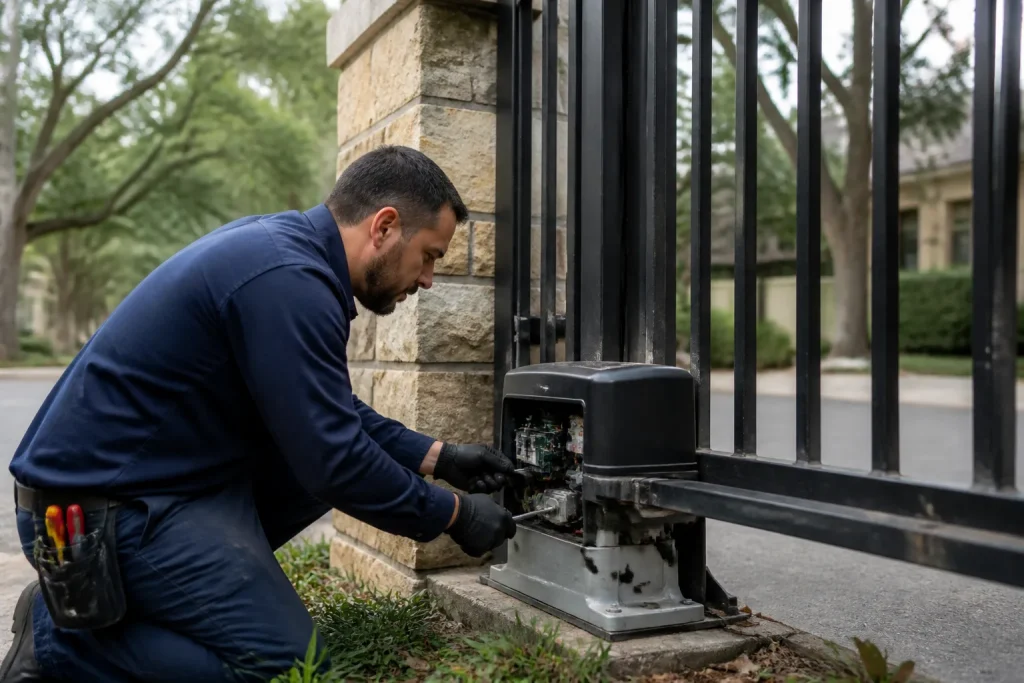
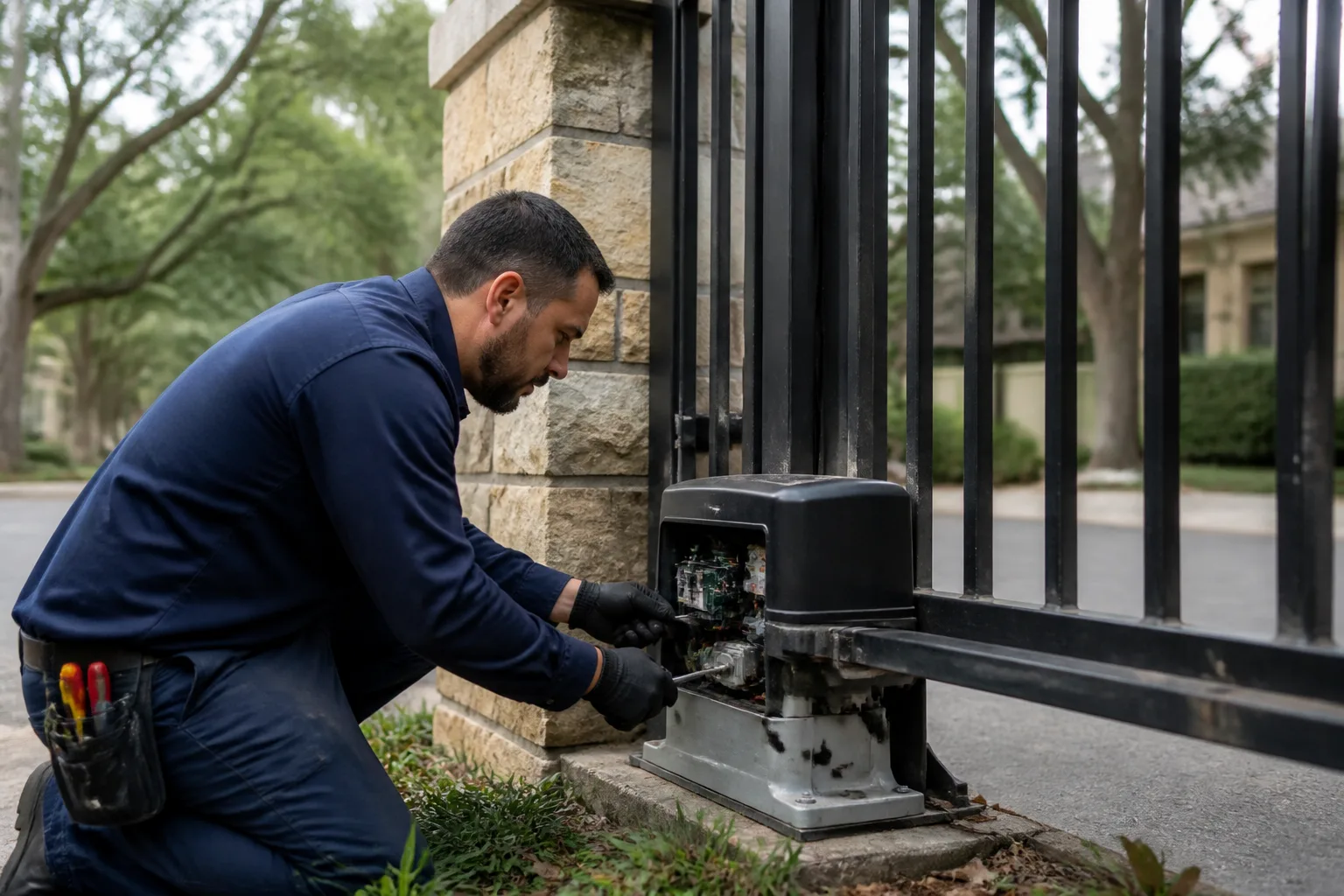
BFT Gate Repair in Highland Park: A Homeowner’s Guide
BFT gate operators fail in a predictable sequence, and that sequence almost always begins with a fault code that got ignored for weeks. Most BFT models in Highland Park driveways store their own error history onboard, blinking a sequence of LED flashes that tells you exactly which component failed and when. If you learn to read those lights before you call for service, you’ll know whether you’re looking at a $180 limit-switch fix or a $900 control-board replacement. And if you’d rather skip the reading and go straight to a repair, call Ironworks Gate Co. at (936) 277-6521 and we’ll handle it.
What a BFT Gate Tells You Before It Quits
Here’s the thing most Highland Park homeowners don’t know: your BFT operator has been talking to you for weeks. The PHOBOS and IGEA residential models, which we see on perhaps six out of every ten BFT-equipped driveways in the Park Cities area, run self-diagnostics every single cycle. When a component starts to drift out of spec, the control board logs it and blinks a pattern on the LED. The gate doesn’t just stop one morning out of spite. It tried to tell you first.
On a PHOBOS D or PHOBOS L, the diagnostic LED sits on the board inside the operator housing. You don’t need tools to read it. A slow, steady flash means the board is powered and idle. Two quick flashes followed by a pause usually indicates a photocell obstruction or wiring fault on the safety input. Three flashes typically points to the limit switch circuit. Four means the motor capacitor is failing under load. On newer IGEA units, the fault memory stores the last eight error events, retrievable through the display. We’ve had Highland Park customers call us describing the blink pattern, and we can often tell them over the phone whether they need a service call or a simple obstruction check.
But here’s where it gets practical. Most repair technicians don’t bother pulling these codes. They swap parts until the gate moves again, charge for the visit, and leave. The homeowner never learns that the capacitor was marginal for six weeks before the board overheated. If a BFT gate in your Highland Park driveway is acting sluggish, refusing to close on the first command, or reversing for no reason, write down the LED pattern before you call anyone. It’s the single most useful piece of information a technician can have.
Highland Park Heat and the Components That Fail First
Highland Park summers are hard on gate equipment. It’s not just the air temperature. It’s the reflected heat bouncing off the pavement, the thermal expansion of the metal post, and the fact that gate operators sit inside dark metal housings that bake all afternoon. In our experience across Ironworks Gate Co. service calls over the years, three BFT components fail most often in this climate, and they fail in the same order.
Capacitors. The motor start capacitor is a cylinder on the control board or beside the motor. Heat degrades the dielectric inside it. Early failure looks like a gate that starts slowly, hums before moving, or trips its thermal overload on hot afternoons but works fine in the morning. A capacitor heading toward failure will often show the four-flash code we mentioned.
Limit switch contacts. BFT uses mechanical limit switches on most residential models. The contacts oxidize over time, especially in humid or salty air, and Highland Park gets plenty of both thanks to the heat and the sprinkler systems that keep those lawns green. When limit contacts degrade, the gate runs too far, slams the end stop, and reverses itself. That’s the gate’s way of saying the switch isn’t reading correctly.
Encoder wheels. BFT’s newer models use an encoder mounted on the motor shaft to track position precisely. The encoder wheel is plastic, and under sustained heat it can develop hairline cracks. When that happens, the board loses position reference, and the gate behaves erratically: midway reversal, ghost-opening, or refusing to hold the closed position. We pulled a BFT operator out of a driveway off Armstrong Parkway last August where the encoder wheel had actually warped into an oval. The gate would close, then reopen six inches and stop.
Why Generic Parts Make a BFT Gate Worse
BFT engineered its residential operators around its own encoder technology, and that’s the one thing a hardware-store part cannot replicate. We understand the impulse. A generic limit switch from the electrical supply shelf costs fifteen dollars, and it looks almost identical. But BFT controllers read position and speed through parameters that assume specific electrical characteristics in the components. Put a generic capacitor with different microfarad tolerance in, and the motor starts drawing current wrong. Put a generic encoder wheel on, and the gate no longer knows where it is.
We see this most often after a well-meaning handyman visit. The gate repairs looks complete. The leaf opens, it closes. The homeowner pays the bill, the handyman leaves, and within thirty days the gate develops a new fault: ghost-cycling at 3 a.m., opening halfway and stopping, or grinding at the end-stops. What happened is the board is compensating for a part that doesn’t match its engineering specs, and the compensation is tearing up the motor. On BFT operators specifically, a board damaged by a mismatched part is usually not repairable. The board replacement, on the IGEA-series residential models, runs $650 to $900 installed in Highland Park. That’s a hard lesson for a fifteen-dollar workaround.
We tell every homeowner who calls us the same thing: if the part did not come from BFT or a BFT-authorized distributor, treat it as temporary at best. At worst, it’s a board killer. The same rule applies whether the operator is a BFT, a Linear, a Viking, or a FAAC. The engineering specs matter more than the shape of the connector.
The Programming Step Most Technicians Skip
When a BFT control board gets replaced, either because of a lightning strike or a slow death from a mismatched part, there’s a programming step that often gets skipped by non-specialist technicians. It’s the torque-learning routine. BFT boards ship with default torque limits set conservatively, and the manual instructs the installer to run the gate through an automatic learning cycle so the board can calibrate current draw against the actual leaf weight and track resistance. It takes about three minutes.
When that step gets skipped, the board operates on factory torque assumptions. In a Highland Park driveway with a heavy iron or steel leaf, the default torque setting might be barely enough to move the gate on flat ground. Add a minor track imperfection, a bit of debris, or a cold morning when the grease thickens, and the board’s obstruction detection trips. The gate reverses mid-cycle. Then it does it again. The homeowner calls back, certain the new board is defective. It isn’t. It was never taught its own gate.
We’ve lost count of the BFT boards we’ve installed on Highland Park gates where the previous repair was just a board swap with no calibration. That ghost-cycling within thirty days of a board replacement is almost always a skipped torque-learning routine. The fix is a service call with a technician who carries the BFT programming documentation and actually reads it.
When the Problem Isn’t the BFT at All
A gate operator lives on top of a gate, and a gate lives on hinges and posts. In Highland Park, where private lanes and rear-entry motor courts are common, the iron underneath the operator takes a structural beating every time a vehicle uses the driveway. Post lean is the big one. The concrete footings in this area sit in clay soil, and clay expands and contracts with moisture. Over twenty or thirty years, a gate post can drift out of plumb by an inch or more. That angle translates to the leaf, which then hangs differently on its hinges.
The BFT operator doesn’t know the post moved. It only knows the gate suddenly requires more current to open at the same speed, or the leaf sags and trips the obstruction sensor. The operator logs an overcurrent fault, and the homeowner assumes the motor is failing. We arrived at one job in Highland Park last spring where the owner was ready to replace a two-year-old BFT IGEA unit. The gate was dragging at the latch end, tripping the safety once every few cycles. The real issue was hinge wear and a post that had shifted. We corrected the iron, rehung the leaf, replaced the worn hinge bushings, and the operator went back to working like new. The customer had been quoted a full operator replacement by someone else. The operator was never the problem.
Before you authorize any BFT repair, ask the technician to check the gate structure: post plumb, hinge play, leaf weight distribution. If the technician doesn’t own a level and doesn’t look at the hinges, you might be putting a fresh $900 board under a gate that will destroy it in eighteen months. The iron is the foundation, and in Highland Park’s clay soil, foundation movement is a fact of life.
When to Call a Pro
Some BFT problems are safe to diagnose and straightforward to fix. An obstructed photo eye, a tripped breaker, or a leaf drifting into the gate path doesn’t need a technician. But anything involving the board, the motor, the capacitor, or the encoder is a different conversation. These are components carrying line voltage and, in the case of the capacitor, storing a charge even after the power is off. A BFT housing that has baked in a Highland Park summer can hold a capacitor charge for hours, and it will deliver it to you in one fast, unforgettable lesson. We say this not to scare you but because we’ve had the call from a homeowner who learned it the hard way. The repair visit cost less than the urgent-care copay.
If you have followed the LED diagnostic and you’re confident it’s a simple obstruction, clear it and see if the gate recovers. If it doesn’t, or if the fault code is anything other than a blockage, that’s a trained technician’s job. Gate repair in Highland Park is a specialized trade. Most of the calls we take involve a gate that’s been misdiagnosed at least once, and the homeowner has already paid for a wrong guess.
The Bottom Line
A BFT gate in a Highland Park driveway is a machine that tells the truth about its own health. The fault codes are there to be read. The components fail in a known order under Texas heat. The fixes are straightforward when the right parts and the right programming are used. The trouble comes when someone skips the diagnostics, uses generic parts, or treats the operator as a bolt-on appliance with no connection to the iron underneath.
Read the LED. Check the obvious. And when the problem needs more than that, call someone who knows BFT equipment the way a Highland Park homeowner knows their own driveway. Ironworks Gate Co. has been serving Highland Park gate installations and repairs for decades, and we stand behind every job with our written 90-Day Done Right Promise. Estimates are free, and a live person answers the phone. Call (936) 277-6521 and we’ll be there when we say.
Frequently Asked Questions
Most BFT repairs in Highland Park fall between $180 and $400 for component-level fixes like limit switches, capacitors, or photocells. Control board replacement typically runs $650 to $900 depending on the model. We quote the full price before any work starts, in writing, and we don’t add surprises to the bill. Call (936) 277-6521 for an exact quote on your specific BFT model.
Yes, most BFT repairs are completed in a single visit. We stock common BFT components on our trucks for the PHOBOS and IGEA lines, which covers the majority of residential operators in Highland Park. If a specific board must be ordered, we’ll tell you upfront and get it moving the same day. Our team answers the phone around the clock, so if your gate is stuck open, call (936) 277-6521 and we’ll get you scheduled.
Random opening, often called ghost-cycling, almost always traces to one of three causes: a skipped torque-learning procedure after a board replacement, a cracked encoder wheel confusing the position sensor, or interference from a neighbor’s remote on a shared frequency. The fix depends on the cause, and the fastest way to narrow it down is to read the onboard fault codes. If you’re in Highland Park and your BFT gate is misbehaving at night, call (936) 277-6521 and we’ll run the diagnostic with you before we even schedule the truck.
BFT controllers calibrate to specific electrical characteristics in their own components. A generic capacitor or limit switch changes the current profile the board expects, which leads to erratic behavior and, in many cases, board failure requiring a $650 to $900 replacement. We only install BFT-compatible components, and our work is covered by the 90-Day Done Right Promise. That means if it isn’t right, we come back and make it right.
Written by Victor Salinas, Owner at Ironworks Gate Co., serving Highland Park since 2013.
Need Gate Repair Help?
Call Ironworks Gate Co. - licensed & insured, here with fast after-hours help in Highland Park.
(936) 277-6521